Policy assessment
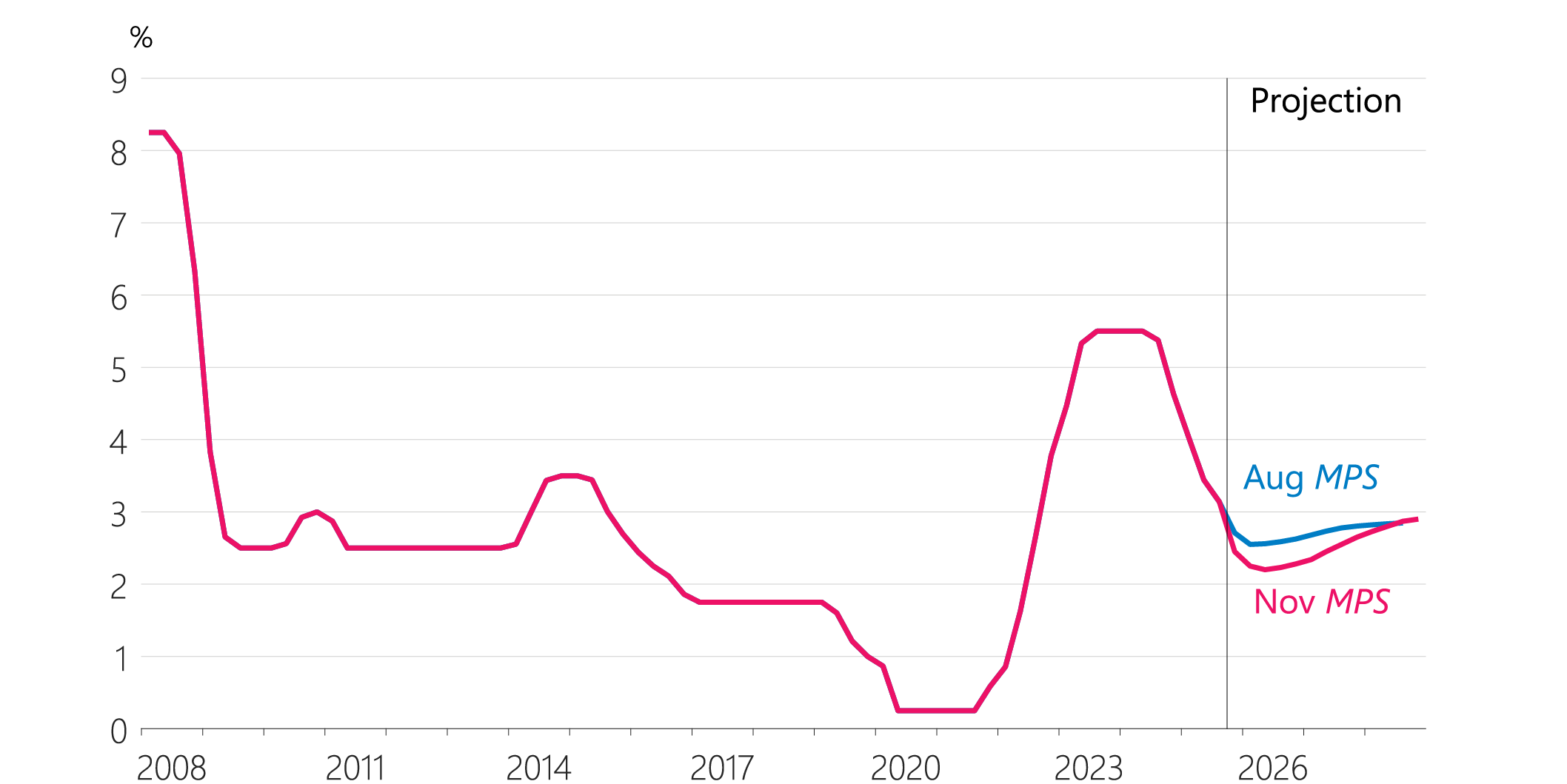
OCR lowered to 2.25%
Annual consumers price inflation increased to 3 percent in the September quarter. However, with spare capacity in the economy, inflation is expected to fall to around 2 percent by mid-2026.
Economic activity was weak over mid-2025 but is picking up. Lower interest rates are encouraging household spending, and the labour market is stabilising. The exchange rate has fallen, supporting exporters’ incomes.
Global economic growth has benefited from strong AI-related investment but is expected to slow in 2026 as trade barriers weigh on activity.
Risks to the inflation outlook are balanced. Greater caution on the part of households and businesses could slow the pace of New Zealand’s economic recovery. Alternatively, the recovery could be faster and stronger than expected if domestic demand proves more responsive to lower interest rates.
The Committee voted to reduce the OCR by 25 basis points to 2.25 percent. Future moves in the OCR will depend on how the outlook for medium-term inflation and the economy evolve.charts
1. Summary record of meeting
Annual consumers price inflation increased to 3 percent in the September quarter, the top of the Monetary Policy Committee’s 1 to 3 percent target band. Significant spare capacity remains in the economy and inflation is expected to fall to around 2 percent by mid-2026. The significant reduction in the OCR since August 2024 is expected to support a recovery in economic activity.
Annual inflation is at the top of the target band but expected to moderate
The Committee noted that both core and non-tradables inflation have continued to decline. Annual tradables inflation increased in September due to petrol prices and high food inflation but is expected to decline over the medium term. Annual headline CPI inflation increased due to higher tradables inflation along with high inflation in household energy costs and local council rates. As these dissipate, this will support headline CPI inflation returning to near the 2 percent mid-point of the target range in mid-2026.
Household inflation expectations have fallen but remain high relative to recent history. The inflation expectations of professional forecasters and business leaders have remained stable at slightly above the 2 percent target midpoint.
The economic recovery stalled in the June quarter
Committee members considered how US tariff policy announcements and broader geoeconomic uncertainty disrupted New Zealand’s nascent economic recovery. Greater uncertainty likely led to increased precautionary behaviour by households and businesses, dampening consumption and investment.
However, while measured GDP declined by 0.9 percent in the June quarter, this likely overstates the weakness in the economy through this period. The Committee noted that an unusually large seasonal balancing item contributed to the weakness in the headline figure. This is expected to be reversed over the next few data releases.
Some industry-specific factors may also have constrained supply. For example, high milk prices and unfavourable weather conditions likely contributed to higher livestock retention and lower meat production in the first half of 2025. Limited access to domestic energy sources and higher energy prices are likely to have weighed on manufacturing more generally.
Significant spare capacity remains
The Committee discussed the balance between supply capacity and demand. In addition to short-run factors, the economy’s medium-term supply capacity has been reduced by weak growth in productivity and the working age population. Estimates suggest that annual potential output growth is currently around 1.5 percent.
Weak economic activity has resulted in significant spare capacity opening in the economy since mid-2024. Unemployment and measures of labour underutilisation have increased, and firms are reporting that it is now relatively easy to find workers. While job losses are not high compared to past economic downturns, job vacancies and job transitions have been low, so it has been relatively difficult for unemployed people to transition back to work.
Economic conditions have been variable across different sectors and regions of the economy. High prices for New Zealand’s commodity exports have lifted incomes in the rural economy. This has supported economic activity in rural areas, although debt reduction by farmers has meant measures of on-farm investment have not yet increased to the extent seen in previous commodity price cycles. The level of economic activity remains low in industries reliant on domestic demand.
Financial conditions have eased and the financial system remains stable
The Committee discussed the easing in domestic financial conditions that has occurred. Wholesale interest rates have declined and the New Zealand dollar Trade Weighted Index has depreciated since August. Cuts to the OCR have reduced borrowing costs and mortgage rates. The average yield on mortgages has fallen to 5.4 percent. With close to 40 percent of fixed rate mortgages due to reprice over the December and March quarters, the average mortgage yield is expected to fall further to 4.7 percent by September 2026 based on current market pricing.
Measures of domestic financial stress have eased as lower interest rates reduce debt servicing pressures. Early arrears, which provide an early indicator of impaired lending, have declined. Non-performing housing loans have also declined, and banks expect further reductions in housing and commercial property impairments over 2026. Non-performing loans in the business sector remain elevated, although at lower levels than in previous downturns.
Economic activity is recovering
Committee members discussed an improvement in near-term indicators of economic activity from their lows in the June quarter, suggesting a return to modest GDP growth in the September quarter. Feedback from recent business visits also suggest that, while activity remains weak, demand has stabilised.
The Committee noted that there are also some early signs of stabilisation in labour demand, with job vacancies and total hours worked increasing in the September quarter. This is expected to broaden into a wider improvement in labour market conditions over coming quarters, which will support household confidence and spending.
Relative weakness in the labour market over the past two years has contributed to higher outward migration from New Zealand, particularly to Australia. Regional disparities in housing and labour markets have also likely encouraged higher internal migration. Outward migration is expected to reduce as the New Zealand economy and labour market recovers, with net migration expected to increase towards long-run trends.
Future growth in house prices is expected to be moderate
Members discussed that house prices, in aggregate, have remained stable to date despite lower mortgage interest rates and a modest pick-up in housing market activity. Stable house prices could reflect weak population growth and elevated long-term interest rates. Supply side reforms in the housing market, such as less restrictive zoning laws, may also be moderating the extent to which increases in housing demand contribute to house price inflation.
The Committee assessed that upcoming reductions in mortgage loan-to-value ratio requirements are unlikely to have a material effect on house prices, especially with debt-to-income restrictions now in place. House price growth is expected to be moderate over the projection period, broadly in line with growth in nominal incomes.
Global growth has been resilient but is expected to slow
Members noted that tariffs have had less impact on the global economy than initially expected, reflecting the imposition of lower tariff rates than originally envisaged, inventory management, and adjustments in global supply chains. Global growth has also been supported by higher investment in artificial intelligence technology, particularly in the US, which has boosted exports from Asia. Higher demand for exports has supported economic growth in China, despite weakness in domestic demand.
Global growth is expected to slow modestly in 2026. This reflects an anticipated weakening in global export demand as the pace of AI investment slows. The Committee still expects trade barriers to weigh on global economic activity and to have a modest disinflationary effect on New Zealand.
Risks to the outlook for inflation are balanced
The Committee discussed the risk that price setting behaviour by businesses may become more sensitive to upside inflation surprises, given recent high inflation and inflation expectations remaining above the target mid-point. Spare capacity in the economy has reduced business profit margins and some restoration in margins is expected as demand improves. This restoration in margins could occur more rapidly than anticipated, which would pose an upside inflation risk.
Members noted there are risks around the speed of the recovery. Some members highlighted the risk that continued caution on the part of households and businesses could further slow the recovery in domestic demand, which could see inflation fall below the target midpoint. Conversely, other members highlighted the possibility of a faster recovery if house prices and household spending increase more quickly than assumed given lower mortgage rates, leading to more persistence in medium-term inflation pressures. Members also discussed the possibility of a stronger increase in on-farm investment stemming from high export commodity prices and the expected return of capital to dairy farmers in 2026 from the sale of Fonterra’s consumer brands business.
The Committee discussed risks to the global outlook. Investment in AI technologies has been a significant driver of global growth and equity returns over the past year. Uncertainty remains around the returns from AI adoption. There is a risk of a more significant correction in equity markets and reduced investment if heightened investor expectations are not met.
Inflation remains high in several advanced economies. Global policy uncertainty also remains high. The Committee noted downside risks to growth in China, as policy makers attempt to maintain growth in the face of weak domestic demand and an increasingly fragmented global trading environment. The Committee also noted uncertainty about US economic policy, and the associated risk of higher US inflation.
The Committee discussed the risk that unsustainable fiscal dynamics and increased politicisation of central banks globally could create the conditions for higher and more persistent inflation.
The Committee voted to lower the OCR to 2.25 percent
The Committee discussed the options of holding the OCR at 2.5 percent and lowering the OCR to 2.25 percent, noting low tolerance for prolonging the return of inflation to the target mid-point.
The case for holding the OCR emphasised the considerable reduction in the OCR to date, which is still working its way through the economy. Economic indicators are recovering, and economic activity is expected to strengthen through 2026. Particular emphasis was placed on the upside risks to inflation and output. Leaving the OCR unchanged at this meeting would provide the optionality to lower the OCR in the future if required.
The case for a further reduction in the OCR emphasised significant excess capacity in the economy. This provides confidence that medium-term inflation will return to, and remain around, the target midpoint. The economic recovery is at an early stage, and the inflation outlook provides scope to place more emphasis on avoiding unnecessary volatility in output and employment. With this context, retention of the easing in overall monetary conditions delivered to date would support an enduring recovery in economic activity.
The Committee discussed how to balance the achievement of their inflation mandate with the need to avoid unnecessary instability in output, employment, interest rates and the exchange rate.
On Wednesday 26 November the Committee voted by 5 to 1 to reduce the OCR by 25 basis points to 2.25 percent. The Committee noted that a reduction in the OCR would help to underpin consumer and business confidence and lean against the risk that the economy recovers more slowly than needed to meet the inflation objective.
Future moves in the OCR will depend on how the outlook for medium-term inflation and the economy evolves.
Attendees:
MPC members: Christian Hawkesby (Chair), Carl Hansen, Hayley Gourley, Karen Silk, Paul Conway, Prasanna Gai
Treasury Observer: James Beard
MPC Secretary: Chris Bloor
2. Economic assessment and monetary policy outlook
Key points
Significant spare capacity in the New Zealand economy is reducing inflationary pressure. Weak economic activity led to the emergence of significant spare capacity in the New Zealand economy in the middle of 2024. This spare capacity is continuing to reduce inflationary pressure. Measures of annual core inflation have declined sharply and are approaching 2 percent. Non-tradables inflation has also declined. Quarterly non-tradables inflation is around historical average rates. Excluding the upward influence of administered prices, quarterly non-tradables inflation is below historical averages.
Inflation is near the top of the Monetary Policy Committee’s 1 to 3 percent target range, but will decline to near 2 percent in the middle of next year. Annual consumers price index (CPI) inflation increased to 3.0 percent in the year to the September 2025 quarter. High inflation rates in a few important categories are holding up overall inflation at present, despite spare capacity in the economy. Prices for food, household energy, and local rates have increased substantially over the past year. We expect annual CPI inflation to return to near the 2 percent mid-point of the target range in the middle of 2026, as inflation rates for these items decline, price-setting behaviour adapts to a low-inflation environment, and spare capacity continues to reduce underlying inflation. Spare capacity in the economy is assumed to be absorbed over the medium term, supporting annual CPI inflation to stabilise at 2 percent as price-setting behaviour adjusts. Inflation expectations from our Survey of Expectations are slightly above 2 percent across short and long horizons.
Significant OCR reductions since August 2024 are supporting demand, which will contribute to spare capacity being absorbed over time. The MPC has reduced the OCR from 5.50 percent in mid-2024 to 2.50 percent following the October 2025 Monetary Policy Review. These reductions have resulted in significant easing in financial conditions for households and firms in New Zealand. Borrowing rates have declined and the New Zealand dollar exchange rate has depreciated. We expect economic growth to increase as this easing transmits to stronger demand, resulting in spare capacity being absorbed over time. High dairy, meat, and horticulture prices are also supporting demand via higher incomes in the agricultural sector, although this has only had a limited flow through to stronger investment. In contrast, subdued growth in government spending, low net immigration, and higher global tariffs are reducing demand.
Conditional on the central economic outlook, we project that the OCR will be lower than at the time of the August Statement. This mostly reflects our assessment of a larger degree of spare capacity in the economy over 2025 and a lower outlook for export prices. A lower path for the OCR is required to keep inflation near 2 percent over the medium term. Price-setting behaviour is assumed to continue to adapt to a low-inflation environment, easing inflationary pressure. Therefore, if the output gap does not close as projected, inflation will decline below 2 percent, all else equal. The outlook for output, inflation, and interest rates is subject to considerable uncertainty.
Economic assessment
Economic activity contracted in the June 2025 quarter
The New Zealand economy contracted by 0.9 percent in the June 2025 quarter, following 0.9 percent growth in the March 2025 quarter (figure 2.1). Reported quarterly GDP has been more volatile than usual, likely overstating true volatility in economic activity.1 Notwithstanding this, GDP was 0.6 percent lower than a year earlier, consistent with continued weakness in economic activity over this period. Over the past year, activity in goods-producing industries has declined, outweighing positive but low growth in the primary and services sectors. The level of activity remains low in industries reliant on domestic demand, including retail, construction, and parts of manufacturing. Energy shortages have also contributed to weaker economic activity in some sectors.

Economic growth has likely resumed, and will increase as lower interest rates transmit to higher demand
Timely indicators of activity suggest the economy grew in the September 2025 quarter. Most timely indicators of economic activity have improved since the June 2025 quarter. This includes the Performance of Manufacturing Index and the Quarterly Survey of Business Opinion (QSBO). The Performance of Services Index remained at a subdued level in the September quarter. Employment was unchanged in the September quarter, but hours worked increased 0.9 percent. The Reserve Bank’s GDP nowcasting model, Kiwi-GDP, incorporates information from these indicators and others. It also suggests GDP is likely to have grown in the September 2025 quarter. On balance, timely indicators suggest a low but positive growth rate in the September 2025 quarter. This is also consistent with our recent discussions with firms, many of whom noted that while the level of activity remains weak, demand has begun to stabilise (see box A).
Box A: Summary of recent business visits
We regularly meet with a range of businesses to improve our industry knowledge and understanding of economic conditions. In October, Reserve Bank and Treasury staff spoke with businesses and industry organisations across New Zealand. Overall, we heard similar messages from businesses to our previous round of discussions in July.
Overall, businesses reported that demand and activity remain subdued, although the agricultural sector reported robust demand. Demand for New Zealand meat, dairy, and horticulture products has continued to be strong. Higher commodity prices and the depreciation in the New Zealand dollar are supporting exporter incomes (see chapter 4.1). In contrast, firms in industries more reliant on domestic demand, such as construction and retail, continued to report weak demand. Many firms reported that demand has stopped deteriorating but is yet to meaningfully pick up.
Businesses reported an easing in overall cost pressures. In aggregate, costs are not growing as quickly as recent years. However, the weaker New Zealand dollar has increased costs for imported materials, and businesses noted that energy and insurance costs remain at elevated levels. Lower interest rates have reduced debt-servicing costs for many firms, including farmers and growers with high debt levels. Businesses continued to report difficulties passing on costs to customers due to weak demand. Domestic customers were noted as being very price sensitive. Some businesses are relying on discounting to maintain sales, resulting in profit margins being squeezed. Exporters were an exception to this, with many businesses reporting they were able to pass on higher costs to customers due to strong demand.
Labour market conditions remain weak. Businesses reported a high volume of applications for vacant roles. Some businesses are choosing not to fill vacancies, and most are cautious about increasing their headcounts. Overall, businesses reported very low levels of staff turnover, with average staff tenure increasing across all sectors. Weak labour market conditions were resulting in smaller wage increases than in recent years.
Investment intentions remain subdued, reflecting weak demand and uncertainty about the economic outlook. Larger businesses with strong balance sheets and some in stronger-performing export sectors reported cautiously continuing investment. More domestically oriented businesses noted that their investment plans were more focused on managing costs and maintaining existing facilities.
Overall, feedback from businesses supports our near-term projections for the New Zealand economy. Demand has stopped deteriorating. Easing overall cost pressures and continued low pricing power are consistent with our projection for consumer price inflation to decline in 2026.
We assume that GDP expanded by 0.4 percent in the September 2025 quarter, and that growth will increase in the December 2025 quarter. We assume that weak economic activity in the June 2025 quarter partly reflected temporary factors, such as a decline in export volumes following strength earlier in the year, high global economic uncertainty, energy shortages, and measurement challenges. Our projection for GDP growth over the second half of 2025 is similar to the August Statement. GDP growth is expected to increase as lower interest rates continue to transmit to domestic demand, high export commodity prices support incomes, and the effect of temporary factors weighing on activity wane. Available timely indicators are consistent with GDP growth increasing in the December 2025 quarter. However, the level of GDP is assumed to be slightly lower over the projection period than at the time of the August Statement.
Household spending is growing at a subdued pace
Household consumption increased over the first half of 2025 (figure 2.2). Consumption grew by 1.5 percent in the year to the June 2025 quarter. This rate of growth is slightly faster than population growth, but below historical averages. The weak labour market, low real income growth, and falling real household wealth (due to falling real house prices) have been restraining consumption (see chapter 4.1 in the August Statement). Household consumption growth is assumed to increase over the projection, supported by lower interest rates. Higher population growth, stabilising real wealth, and higher real incomes – including from higher primary sector revenue – are also assumed to support consumption.

Government expenditure is assumed to decline as a share of the economy
Government expenditure (consumption and investment) has declined as a share of the economy since late 2021, but increased over the first half of 2025. We assume that government expenditure grows at a historically subdued pace over the medium term, and so declines further as a share of the economy. Our projections are consistent with Budget 2025, adjusted for the higher-than-assumed level of government expenditure in the June 2025 quarter.
Private investment is expected to be subdued this year, but increase over the medium term
Business investment contracted in the June 2025 quarter, following increases in the previous two quarters. Weak business investment likely reflects both significant spare capacity in the economy and elevated global uncertainty (see chapter 4.1 in the May Statement). Business investment is expected to remain weak in the September 2025 quarter, before increasing over the medium term as GDP growth strengthens and the effects of global uncertainty wane.
Residential investment remained broadly stable over the first half of 2025, following two years of significant declines. We expect residential investment to begin increasing from late 2025, consistent with increases in dwelling consents issued in recent months. Lower interest rates, higher population growth, government initiatives to improve housing supply, and modest increases in real house prices are assumed to encourage more residential construction over the medium term.
Net immigration has slowed, reducing potential GDP growth
Net immigration to New Zealand has remained historically low since late 2024 (figure 2.3). This is partly due to weak economic and labour market conditions in New Zealand, especially relative to Australia. Slow population growth is weighing on consumption growth and housing demand, but is also reducing growth in labour supply. Our projections assume that annual potential GDP growth is currently around 1.5 percent. This is below historical averages, largely reflecting slow population growth, but also weak productivity. Annual potential GDP growth is assumed to increase to about 2.5 percent in 2028, as population growth increases and productivity growth improves gradually towards the rate estimated prior to the COVID-19 pandemic.
The New Zealand economy has significant spare capacity
Significant spare capacity in the New Zealand economy has opened up since the middle of 2024. Volatility in quarterly GDP is resulting in volatility in our estimated output gap, but we estimate that the output gap will average about -1.5 percent of potential GDP over 2025 (figure 2.4). Our estimate of the output gap over the second half of 2025 is slightly lower than assumed in the August Statement, consistent with lower economic activity and continued weakness in our suite of capacity pressure indicators.
The output gap is assumed to close over the medium term as GDP growth begins to outpace potential from late 2025. GDP growth is assumed to strengthen as lower interest rates continue to transmit to stronger demand, and the dampening effect of high global economic uncertainty wanes.


The labour market remains weak
Demand for labour is weak due to subdued economic activity, but appears to be stabilising. Employment was unchanged in the September 2025 quarter, following four quarters of consecutive declines. However, employment was 0.6 percent lower in the September 2025 quarter than a year earlier, while the working-age population grew by 0.9 percent over the same period. While job vacancies remain well below pre-COVID-19 levels, they have increased slightly in recent months. Total hours worked and paid increased in the September 2025 quarter, which may also indicate stronger labour demand.
A range of measures suggests that labour market capacity pressures eased substantially during 2024 and over 2025 to date. Most measures of labour market tightness are below their average levels since 2000 (figure 2.5). Some measures are at or close to their weakest levels since 2000. However, changes across the suite of measures were more mixed in the September 2025 quarter than in previous quarters. Overall, the range of measures is consistent with our assumption that the degree of spare capacity in the labour market and economy overall is substantial, but smaller than following the Global Financial Crisis (see chapter 4.2). The unemployment rate increased to 5.3 percent in the September 2025 quarter, and is assumed to remained broadly unchanged in the near term (figure 2.6). Over the medium term, the unemployment rate is projected to decline as economic growth recovers.
Spare capacity in the labour market and lower inflation are contributing to slower nominal wage growth. Annual same-job wage growth, as measured by the labour cost index (LCI, ordinary and overtime, private sector) was 2.1 percent in the September 2025 quarter, down from a peak of 4.5 percent in early 2023. Wage growth is assumed to remain around this level over the medium term.


Global economic growth has been resilient to higher tariffs so far
Economic growth in New Zealand’s major trading partners has been resilient to higher global tariffs so far (see chapter 3). While higher tariffs and elevated global uncertainty are likely weighing on demand and production, GDP growth in New Zealand’s trading partners has not fallen as initially expected when the US announced much higher tariffs in early April. This resilience reflects a range of factors, including:
- US tariffs coming into effect at lower levels than originally announced on many economies, with exclusions for certain goods (and most economies not retaliating);
- global trading patterns adapting to higher tariffs;
- built-up inventories allowing US firms to pass through the cost of higher tariffs to their customers more slowly; and
- large-scale investment related to artificial intelligence in the US and associated strong demand for semiconductors and electronic equipment produced in Asia.
Forecasts for global growth have increased in recent months (figure 2.7). Consensus forecasts were initially downgraded sharply following the announcement of higher tariff rates by the US in early April. As economic growth has remained resilient, forecasts for growth this year have been revised upward, fully reversing the initial decline. However, forecasts for growth in 2026 have increased only slightly.
Headline inflation in New Zealand’s trading partners has declined over the past year. Annual inflation in China is slightly negative, in part reflecting spare capacity in some industrial sectors. Inflation in the US has increased in recent months, albeit by less than forecasters expected, as firms have passed on some of the cost of higher tariffs to consumers. In aggregate, consensus forecasts for inflation in New Zealand’s major trading partners have declined throughout this year (figure 2.8).


Higher tariffs and uncertainty are likely reducing inflationary pressure in New Zealand
Declining inflation in most of our trading partners and high global uncertainty are likely reducing inflationary pressure in New Zealand. Our assumptions about the effects of tariffs and uncertainty are similar to those in the August Statement (see chapter 5). However, disentangling the effects of these developments on the New Zealand economy from other factors is difficult.
New Zealand export prices have increased substantially, supporting incomes. Prices for New Zealand’s exports increased substantially between late 2024 and the middle of this year. Dairy, meat, and horticulture prices have accounted for most of the increase. Higher prices have reflected both increasing demand and reduced global supply for some of our key export commodities. High export prices are supporting incomes and spending in New Zealand. However, transmission of higher export prices to the economy appears to have differed from previous episodes of increasing export prices (see chapter 4.1). Farmers have been paying down debt, and measures of on-farm investment have remained relatively subdued. In addition, the New Zealand dollar exchange rate has depreciated since late 2024, when it has appreciated in most prior episodes.
Timely measures indicate that aggregate export prices will decline over the second half of 2025 (figure 2.9). Timely measures of dairy prices have declined materially since the start of the year. We assume that this leads to New Zealand export prices declining in aggregate over the second half of 2025. This reflects the normal lag between timely commodity price indicators and official measures of export prices. Over the medium term, we assume that export prices settle near historical average levels in real terms.

Export volumes declined in the June 2025 quarter. Goods export volumes declined in the June 2025 quarter, although they remained higher than in the second half of 2024. Some export shipments may have been brought forward into the March 2025 quarter due to uncertainty about global tariff policy. Higher prices are encouraging increased production for some export goods, such as dairy and fruit. Service export volumes declined slightly in the June 2025 quarter, to a similar level to a year prior. We assume that service export volumes grow faster than the overall economy over the medium term, supported by increasing international flight capacity to New Zealand. However, we assume that service exports remain a smaller share of overall economic activity than before the COVID-19 pandemic over the medium term.
The New Zealand dollar exchange rate is lower than at the time of the August Statement. International oil prices are slightly lower. The lower New Zealand dollar exchange rate mostly reflects developments in New Zealand, in particular lower interest rates (see chapter 3).
Inflation is near the top of the MPC’s target range, but expected to return near the 2 percent target mid-point in the middle of 2026
Annual headline CPI inflation increased to 3.0 percent in the September 2025 quarter. Annual non-tradables inflation decreased to 3.5 percent, as expected in the August Statement. Annual tradables inflation increased to 2.2 percent, slightly higher than expected in the August Statement.
Annual core inflation measures have declined significantly since 2023, but remain in the top half of our target range (figure 2.10). Movements in annual core inflation measures were mixed in the September 2025 quarter, with the average of measures declining slightly to 2.4 percent. Quarterly measures of core inflation were unchanged on average in the September 2025 quarter, and are at a rate consistent with 2 percent inflation if sustained.

Inflation expectations of professional forecasters and business leaders remain slightly higher than 2 percent (figure 2.11). 1-year ahead inflation expectations from our Survey of Expectations remained unchanged at 2.4 percent in the December 2025 quarter. 10-year ahead inflation expectations were unchanged at 2.2 percent. Mean 1-year ahead household inflation expectations eased slightly in the December 2025 quarter, but remain relatively high. Household inflation expectations are high across many advanced economies, possibly reflecting global factors such as higher tariffs and increasing food prices (see chapter 4.2 in the August Statement). 1- and 2-year ahead inflation expectations from our Business Expectations Survey declined to 2.4 percent in the December 2025 quarter.

Annual tradables inflation increased to 2.2 percent in the September 2025 quarter from 1.2 percent in the June 2025 quarter (figure 2.12). Slower disinflation in petrol prices accounted for most of the increase in annual tradables inflation in the quarter. Continued high inflation for food and recreation accounts for tradables inflation being above its historical average. For example, prices have been rising for dairy, meat, fruit, vegetables, overseas accomodation, and streaming services. Annual tradables inflation is expected to decrease over the medium term as inflation in food and recreation eases. The depreciation in the New Zealand dollar exchange rate since the middle of 2025 is likely to moderate the decline in tradables inflation over the next year.
Annual non-tradables inflation continues to decline, from 3.7 percent in the June 2025 quarter to 3.5 percent in the September 2025 quarter (figure 2.13). Declining non-tradables inflation reflects spare capacity in the economy and price‑setting behaviour adapting to a low‑inflation environment.


Inflation in administered prices is contributing significantly to non-tradables inflation. While annual administered inflation eased in the September 2025 quarter, it remains very high compared to its historical average (figure 2.14).2 In contrast, annual inflation in non-tradables categories that are relatively sensitive to monetary policy is below pre-COVID-19 rates.3 For instance, annual new dwelling construction inflation was 0.8 percent in the September 2025 quarter, its lowest level since 2009. Quarterly non-tradables inflation is around pre-COVID-19 rates, and lower excluding the upward influence of administered prices.

Spare capacity in the economy will continue to flow through to lower non-tradables inflation over the coming year. Price-setting behaviour is assumed to continue to adapt to a low-inflation environment over the medium term, placing downward pressure on non-tradables inflation. We expect inflation rates to decrease across a range of non-tradables categories. Lower growth in labour costs will contribute to lower inflation, particularly for labour-intensive services. Rental inflation will continue to decrease. Rental inflation for new tenants has declined significantly, reflecting low population and income growth, and this is feeding through to lower inflation for the stock of rentals over time. The negative output gap is projected to close over the medium term, resulting in annual non-tradables inflation stabilising at around 3 percent in the second half of the projection period.
Inflation for non-tradables items less sensitive to monetary policy is high, but has begun to ease. Local authority rate increases — which take effect in September quarters — are contributing significantly to non-tradables inflation. While rate increases for 2025 were lower on average than last year, they are still substantially higher than historical averages. Household energy price inflation has increased substantially over the past year, and increases in electricity lines charges regulated by the Commerce Commission added significantly to prices in the June 2025 quarter. While further lines charge increases will occur in future years, these will be smaller than the 2025 increase. Insurance inflation has fallen from high rates experienced following severe storms and floods in 2023 and is likely to decline further over the next couple of quarters. We expect administered inflation to ease over time in line with lower general inflation pressures, but to remain higher than other non-tradables categories for some time.
Annual headline inflation is forecast to return to near the 2 percent target mid-point by the middle of 2026 (figure 2.15). Inflation for food, household energy, and local rates is currently well above historical averages, resulting in headline inflation at the top of the MPC’s 1 to 3 percent target range. The expected decline of annual CPI inflation reflects both continued broad-based easing in underlying inflation and lower rates of inflation for food and administered prices. Quarterly CPI inflation is at a level consistent with annual inflation near 2 percent if sustained.

Monetary policy outlook
Conditional on the central economic outlook, we project that the OCR will be lower than at the time of the August Statement (figure 2.16). The MPC has been reducing the OCR since August 2024 as inflationary pressures have eased. Lower interest rates will support the output gap to close over the medium term, and hence inflation to settle near the 2 percent target mid-point. We assume that price-setting behaviour continues to adapt to a low-inflation environment, easing inflationary pressure. Therefore, if the output gap does not close, inflation will decline below 2 percent, all else equal. Over the medium term, the OCR is assumed to return towards the middle of our range of long-term neutral estimates (see box B, chapter 5). Compared to the August Statement, the lower projected OCR mostly reflects our assessment of a larger degree of spare capacity in the economy over 2025 and a lower outlook for export prices. The outlook for output, inflation, and interest rates is subject to considerable uncertainty.

3. Global economy and financial markets
Key points
The global economy has proved more resilient than anticipated so far in 2025 but global growth is expected to slow modestly in 2026. The effects of tariffs on the global economy have been less significant than initially anticipated. Additionally, demand for inputs for investment in artificial intelligence (AI) technology has supported exports from our trading partners in Asia. Trade barriers still present a headwind to global growth, with trading-partner growth expected to weaken over the course of 2026.
Inflation remains low in China and much of emerging Asia, but has increased in some advanced economies since the start of the year. Excess supply is keeping inflation low in China and weighing on inflation across the broader region. Tariffs are adding to upward pressure on US inflation, though their impact has been smaller than expected so far. Domestic inflationary pressures have increased in Australia.
Financial and economic conditions across advanced economies have diverged over the past year. Differences in monetary policy settings reflect varied outlooks for activity and inflation over the medium term. Global equity markets remain strong, led by continued gains in the US technology sector. The US dollar has stabilised, but remains significantly below its level at the start of the year. Oil prices have fallen to around their lowest levels in about four years amid strong supply and easing geopolitical tensions in the Middle East.
Domestic financial conditions have eased since the August Statement. Wholesale interest rates have declined, and the New Zealand dollar (NZD) trade-weighted index (TWI) has depreciated. These developments largely reflect weaker domestic data and downward revisions to market participants’ expectations for the OCR. Mortgage and term deposit rates continue to decline, and bank funding costs have increased.
Global economic conditions
Global growth has been more resilient than expected
Global growth forecasts for 2025 have continued to be revised higher, in part due to a surge in artificial intelligence investment. Bloomberg consensus forecasts for many of New Zealand’s trading partners have been revised higher since the August Statement. Annual New Zealand trade-weighted global growth is expected to be 2.9 percent in 2025. Expectations have improved materially since the low of 2.4 percent at the time of the May Statement. Forecasts are now similar to expectations at the start of this year, and to the pace of growth in 2024 (figures 2.7 and 3.1).

US import demand and the adjustment of global supply chains to tariffs, particularly across Asia, have bolstered global growth. Forecasts for several Asian economies have been revised upwards this year, including China and Taiwan where investment in AI-related technology has supported export demand. US GDP growth has also been supported by significant investment in AI infrastructure.
Annual trading-partner growth is anticipated to slow to 2.6 percent over 2026, unchanged from the August Statement. This slowdown largely reflects expectations of weaker global trade. This is partly accounted for by a slowdown in the pace of growth in AI-related investment and continued price pressures from higher tariffs in the US.
Chinese growth has remained robust, supported by strong exports despite ongoing weakness in domestic demand. China’s economy grew by a stronger-than-expected 4.8 percent in the year to the September 2025 quarter. Over the same period, exports increased 6.7 percent, but domestic demand has softened. Retail sales grew just 2.6 percent in the year to the September quarter, the weakest rate since August 2024, while fixed asset investment has fallen to its lowest level outside of the COVID-19 pandemic.
Despite these challenges, medium-term growth forecasts for China have been revised higher. This comes following the recent Fourth Plenum of the Communist Party’s Central Committee, where authorities reaffirmed long-term GDP growth targets consistent with average annual GDP growth of between 4 and 5 percent over the next decade.
Some of our key trading partners are facing upward pressure on inflation
Trading-partner inflation has increased, but by less than expected at the start of the year. Aggregate annual trading-partner inflation declined to 1.6 percent over the first half of the year and is expected to average 1.8 percent in 2025. This is lower than the 2.2 percent expected at the beginning of 2025. Two factors have affected this: tariffs have had a smaller effect on US inflation than expected, and deflationary pressure has continued in China. Annual trading-partner inflation has since increased to 1.8 percent in the September quarter and is expected to rise further to an average of 2 percent in 2026 (figure 3.2).

Inflation in China remains low but is expected to increase. High manufacturing capacity in China has contributed to deflation over most of 2025. However, a recently launched campaign to reduce ‘oversupply’ is expected to put upward pressure on inflation over the medium term. In the year to October, consumer prices increased 0.1 percent and producer prices fell 2 percent. Low Chinese inflation is exerting downward pressure on inflation in other economies in Asia.
US inflation has continued to increase gradually and is expected to stay elevated over the coming year. CPI inflation increased to 3 percent in the year to September, largely due to rising goods prices offsetting declining inflation in key categories like energy and rents. The pass-through of tariff costs to consumers has been slower than expected. The effective tariff rate on US imports has been lower than initially estimated, as firms have delayed tariff payments, shifted to other suppliers, and drawn down inventories imported before the tariffs were imposed. Where tariffs have been incurred, firms have been cautious in raising prices significantly. In addition, reductions in hiring and lower wage increases have limited the impact on profit margins. With inventories depleting and fewer options to delay tariff payments, pass-through to consumer prices has increased in recent months. Bloomberg consensus forecasts imply further tariff pass-through, contributing to elevated inflation over the next year.
Australian inflation has increased in response to domestic capacity pressures. Annual headline inflation in Australia increased from 2.1 percent in the June quarter to 3.2 percent in the September quarter as energy subsidies expired. Underlying inflationary pressure has increased. Annual trimmed mean inflation, the Reserve Bank of Australia’s (RBA) preferred measure of core inflation, rose to 3 percent in the September quarter. This was materially higher than anticipated, prompting the RBA to revise up their assessment of capacity pressure.
Global financial conditions
Divergent economic and monetary policy developments have led to varied movements in global interest rates
Differences in monetary policy settings reflect varied outlooks for activity and inflation over the medium term. Since the August Statement, the Federal Reserve and Bank of Canada have lowered their policy rates, while the European Central Bank, Bank of England, and the RBA have left theirs unchanged. Financial market participants still expect most major central banks will continue easing, but the extent of this varies (figure 3.3).
Policy rate expectations and short-term bond yields in the US, Canada, and New Zealand have declined. Weak economic activity has prompted further easing from several central banks, putting downward pressure on short-term yields. In contrast, the Australian 2-year yield has increased since the August Statement, in response to greater capacity pressure in the economy.
Term premia and global long-term rates have decreased as US economic uncertainty has eased. The US 10-year government bond yield has declined 15 basis points, as the term premium has declined. Term premia reflect the additional compensation demanded by investors for holding long-term assets. Greater uncertainty about the future of the economy had caused term premia in the US and globally to rise over the first half of the year. As tariffs have settled at a lower level than initially expected and the economic outlook has appeared less uncertain, term premia have declined over recent months. This has put downward pressure on long-term rates globally (figure 3.4).


Global equity prices have continued to increase. The US S&P 500 index has increased 2.9 percent since the August Statement, supported by ongoing optimism about AI, continued monetary policy easing, and strong corporate earnings reports. Rising valuations continue to be highly concentrated in the technology sector. The Japanese Nikkei 225 index has increased 14 percent since the August Statement, partly reflecting expectations for more accommodative fiscal policy. Increases in other major equity markets have been smaller. For example the Euro Stoxx 50 index has increased 0.5 percent since the August Statement.
Oil prices have declined to around their lowest level since early 2021. Brent crude oil is trading at USD 64 per barrel, 4.6 percent lower than at the time of the August Statement (figure 3.5). The decline largely reflects a strong supply outlook and easing geopolitical tensions in the Middle East.
The US dollar has appreciated but remains weak relative to recent history. The US dollar index has appreciated 2 percent since the August Statement, after falling 10 percent between January and August. The move comes despite US policy rate expectations falling by more than elsewhere, potentially reflecting an easing of investor concerns about policy uncertainty in the US.

Domestic financial conditions
Market participants have lowered their expectations for the OCR
Market participants have significantly reduced their expectations for the level of the OCR over the next year (figure 3.6). This is consistent with weaker-than-expected domestic GDP data for the June quarter (see chapter 2), and a faster pace of monetary policy easing compared to market participant expectations at the time of the August Statement. Wholesale interest rates have fallen since the August Statement, largely because of the same factors (figure 3.7). Domestic wholesale interest rate rates have declined by more than US and Australian rates, reflecting differences in expectations for growth, inflation, and monetary policy across each economy.


The New Zealand dollar has depreciated
The NZD TWI has depreciated by 4.4 percent since the August Statement (figure 3.8). The depreciation in the NZD has been broad-based, with the NZD depreciating against most trading-partner currencies since the August Statement. The real NZD TWI, which accounts for changes in relative price levels between New Zealand and our trading partners, has fallen by less than the nominal TWI over the past year.

Falling New Zealand interest rates have been the main driver of the lower NZD TWI. The spreads between the 2-year New Zealand interest rate swap and equivalent rates for the US and Australia have fallen to low levels (figure 3.9). Higher export commodity prices over much of 2025 have contributed to the NZD TWI remaining higher than otherwise, although timely measures of dairy prices have declined since the middle of 2025 (see chapter 4.1). Global risk sentiment has also been supportive, with measures such as the MOVE and VIX indices remaining at relatively low levels.

Mortgage rates have followed wholesale rates lower
Mortgage and term deposit rates have fallen at all terms since the August Statement. Advertised mortgage rates peaked in December 2023 and have declined broadly in line with falls in equivalent wholesale rates, albeit with a lag (figure 3.10). The spread between 2-year mortgage rates and 2-year swap rates has been broadly stable since late 2023.
The average mortgage yield has continued to decline as borrowers re-fix on lower interest rates (figure 3.11). The average yield has decreased from its peak of 6.4 percent a year ago to 5.4 percent in September. The average mortgage yield will continue falling in coming months as the stock of mortgage lending continues to re-fix on lower rates.


The weighted average cost of new bank funding has risen
Our estimate of the spread between the cost of new bank funding and short-term wholesale rates has increased since the August Statement. This is because interest rates on term deposit, saving, and transaction accounts have fallen by less than equivalent wholesale interest rates over this period (figure 3.12).
Credit growth has recovered as interest rates have fallen. Stronger credit growth could put upward pressure on bank funding costs by increasing competition for retail deposits or causing banks to increase their reliance on wholesale funding sources. However, banks remain well funded, in part due to annual growth in system-level deposits exceeding lending growth since mid-2023.
Domestic and offshore wholesale funding conditions remain favourable. Investment-grade credit spreads for financial institutions are at historically low levels. Recent periods of illiquidity in domestic and global short-term funding markets have not had a major impact on key domestic wholesale funding spreads.

4. Special topics
Before the publication of each Statement, Reserve Bank staff provide analyses of some topical issues to the Monetary Policy Committee.
Topics for the November Statement included:
- How are high commodity prices affecting the New Zealand economy?
- A closer look at our measures of labour market spare capacity
| Topic and date | |
| Household sector developments and outlook - August 2025 Statement (Chapter 4) | |
| Assessing developments in inflation expectations - August 2025 Statement (Chapter 4) | |
| How does uncertainty affect the New Zealand economy? - May 2025 Statement (Chapter 4) | |
| The transmission of higher global tariffs to the New Zealand economy - May 2025 Statement (Chapter 4) | |
| The implications of global tariffs for the New Zealand economy - February 2025 Statement (Chapter 4) | |
| Outlook for some of New Zealand’s key commodity exports - February 2025 Statement (Chapter 4) | |
| Trends in production sectors of the New Zealand economy - November 2024 Statement (Chapter 4) | |
| Summary of recent business visits - November 2024 Statement (Chapter 4) | |
| Real interest rates and their effect on the economy - November 2024 Statement (Chapter 4) |
1. How are high commodity prices affecting the New Zealand economy?
Summary
- Prices for New Zealand’s commodity exports have a major influence on the New Zealand economy. Goods exports make up about 70 percent of New Zealand’s total exports, and about 18 percent of nominal GDP. As a result, commodity export prices have a large influence on New Zealand exporter incomes, and on investment and spending decisions in the economy.
- Recently, global conditions for New Zealand’s key export commodities have been favourable for New Zealand exporters. Global supply constraints for some of New Zealand’s key export goods, as well as robust global demand, have kept their prices elevated. This is particularly the case for dairy, meat, and horticulture products.
- After adjusting for inflation, export commodity prices are only slightly above recent historical averages in foreign currency terms. In contrast to most of the previous episodes of elevated export prices, the recent depreciation of the New Zealand dollar is further supporting exporter returns.
- Lower on-farm cost inflation and elevated commodity export prices have supported a recovery in exporter margins. On-farm expenses grew faster than headline inflation, which contributed to low margins for farmers since 2021. More recently, elevated export commodity prices have supported a recovery in farmers’ margins from these weak levels. Much of this improvement appears to have been used to pay down debt, although more farmers appear to be planning to invest.
- Timely measures indicate New Zealand’s aggregate export prices will decline over the second half of 2025. Much of the recent strength in global export commodity prices can be accounted for by supply-side constraints. Dairy supply constraints are easing and global production is rising, putting downward pressure on dairy prices and, in turn, on overall commodity prices.
- Reserve Bank modelling finds that investment tends to increase, with a lag, following increases in export commodity prices. Given usual lags of up to a year, high export commodity prices in early 2025 are likely to contribute to a moderate increase in business investment over the December 2025 and March 2026 quarters, supported by the output gap closing. However, there is a risk business investment may not respond as strongly as in past periods of elevated export prices. Farmers may continue to deleverage rather than invest. Some farmers may remain cautious after recent seasons of declining margins and may hold back on new investment given the more recent declines in some prices.
Global conditions have contributed to elevated commodity prices for New Zealand exporters
New Zealand’s goods export sector is an important part of our economy, making up about 18 percent of nominal GDP. Over the year to the June 2025 quarter, dairy, meat, and other food and agricultural products made up over 60 percent of New Zealand’s total goods exports. The prices of these products play an important role in influencing New Zealand exporter incomes, and hence local investment and spending decisions.
New Zealand’s goods export volumes have grown at a slow pace, increasing only 0.7 percent in the year to the June 2025 quarter. Over the same period, global prices for New Zealand’s key commodity exports have increased significantly, with nominal goods exports increasing 11.7 percent.
Export commodity prices have increased since late 2023, reflecting both constrained global supply and resilient demand (figure 4.1). Global beef and dairy prices increased as disease outbreaks – including avian flu in the US, and bluetongue and foot and mouth in parts of Europe – reduced production in key markets. Livestock numbers fell across Europe, the US, and China due to diseases, environmental regulation, and the natural cattle cycle. These factors further constrained global meat supply. In addition, demand for New Zealand’s horticulture products remains strong, particularly for goods such as kiwifruit, with prices being supported by robust demand from Asia.

However, real export prices are only slightly above historical averages. After accounting for the high rates of inflation experienced globally since 2021, New Zealand commodity prices are only slightly above recent historical averages in foreign currency terms (figure 4.2).
In contrast to previous periods of elevated export prices, the depreciating New Zealand dollar is increasing returns for our exporters. The real New Zealand dollar ANZ commodity price index peaked in the March 2025 quarter. In US dollar terms, commodity prices are still below their 2022 peak, while they remain slightly above the 2022 peak in New Zealand dollar terms. This difference reflects the significant depreciation in the New Zealand dollar exchange rate over this time. This depreciation differs to most previous periods of elevated export prices, when the New Zealand dollar tended to appreciate in response. For a given level of global export prices, a lower New Zealand dollar exchange rate increases exporter returns.


Farmers’ margins have improved, but investment has remained subdued
Increases in export commodity prices have led to a recovery in farmers’ margins from previously weak levels. During the 2021/2022 increase in commodity prices, farmers’ expenses grew at a faster rate, which led to a narrowing in on-farm margins (figure 4.3). Growth in farmers’ expenses has slowed since late 2022, although overall growth in farmers’ expenses has been slightly higher than headline CPI since 2021. Most of the increase in export commodity prices since early 2024 has resulted in a recovery in farmers’ margins, unwinding the previous weakness. Only the more recent commodity price increases have led to farmers’ returns growing to an above-average level.
Recently, farmers have prioritised debt reduction and balance sheet resilience. Farm cash flows have improved recently, accounted for by higher revenues, falling interest rates, and lower farm cost inflation. This has supported significant deleveraging in the agriculture sector. Farmers appear to be taking a somewhat cautious approach and are looking to increase balance sheet resilience after a period of tight margins.
Higher incomes, particularly for dairy, have so far appeared to have a muted effect on economic activity. Higher exporter margins have had a limited effect on investment as farmers have prioritised debt repayment. More recently, however, some indicators of farmer confidence and farm investment have improved. We expect a moderate pick-up in spending and investment.
Our forecasts assume global commodity prices will decline
Reserve Bank modelling finds that investment tends to increase, with a lag, following increases in export commodity prices. We recently updated previous Reserve Bank modelling and found consistent results.4 Historically, increases in export commodity prices result in stronger business investment, with a peak effect after around a year. This modelling implies that the current period of high export commodity prices is likely to contribute to a moderate increase in business investment over the December 2025 and March 2026 quarters.
Business investment may not respond as strongly as in previous episodes of increasing export commodity prices. Farmers may continue to prioritise debt reduction over new investment. Farmers may remain cautious following recent financial pressures. In addition, recent industry engagements suggest that increasingly binding environmental and regulatory constraints may reduce expansion opportunities compared to history.
Timely measures indicate that New Zealand’s aggregate export prices will decline over the second half of 2025. Despite subdued global growth, demand for New Zealand’s key commodities has remained robust, providing support to prices. However, much of the recent strength in export commodity prices can be accounted for by global supply constraints. Some of these global supply constraints are now easing, and global production is increasing, particularly for dairy. Global milk supply has increased faster than industry expectations, leading to a faster-than-expected fall in dairy prices, as shown by Global Dairy Trade auctions since mid-2025. Our projections assume that New Zealand’s export prices decline over the medium term, settling around historical averages in real foreign currency terms (see chapter 5). In practice, export commodity prices are likely to remain variable, reflecting a range of factors including weather conditions, disease outbreaks, global economic conditions, and trade developments.
2. A closer look at our measures of labour market spare capacity
Summary
- Information about the labour market is crucial for understanding capacity pressure in the economy, and therefore the outlook for inflation. We monitor a wide range of measures of labour market capacity pressure, which examine the labour market from different angles.
- All measures of labour market spare capacity have deteriorated substantially since 2023. The broad weakening in measures supports our assessment that there is a significant degree of spare capacity in the economy. However, there is a wide range of variation between measures, illustrating the uncertainty around our assumptions.
- Compared to history, it is hard for unemployed people to transition back to employment. While the share of workers becoming unemployed is not high compared to the past, job vacancies and job transitions are very low.
- Wage growth is declining, broadly in line with historical relationships. Spare capacity in the labour market and lower inflation are contributing to lower wage growth. Wage growth is currently around levels consistent with annual headline CPI inflation at 2 percent.
- Labour demand may be starting to stabilise. Job vacancies have increased in recent months, and total hours worked increased in the September 2025 quarter. We expect labour market spare capacity to remain broadly stable over the next couple of quarters, before beginning to reduce with a lag once the output gap begins to close.
In this chapter, we discuss five categories that measure labour market capacity pressure: unemployment-based measures, other measures derived from Household Labour Force Survey (HLFS) data, job vacancies and transitions, measures from the Quarterly Survey of Business Opinion (QSBO), and wage growth.5 Finally, we discuss recent developments in timely labour market indicators, and the outlook for labour market capacity pressure.
Most unemployment-based measures show substantial spare capacity
All unemployment-based measures show large reductions in labour market capacity pressure over the past two to three years (figure 4.4). However, unemployment measures demonstrate varying degrees of weakness compared to historical averages. Broad measures, such as the aggregate unemployment rate and the underutilisation rate, remain well below their peaks following the global financial crisis (GFC). However, some of the unemployment measures we consider most cyclical have approached GFC peaks – for example, the youth unemployment rate (aged 15-24 years), and the medium-term unemployment rate (1-12 months unemployed). Higher unemployment among some groups who are most affected by the business cycle may indicate that there is more spare capacity in the labour market than suggested by the aggregate unemployment rate.


Some unemployment measures may be starting to stabilise, consistent with our view that overall slack in the economy is stabilising. The aggregate unemployment rate has increased more slowly this year than in the prior two years. Some measures decreased in the September 2025 quarter, for example Māori and Pasifika unemployment rates. However, other measures have continued to show increasing spare capacity, including regional deviations in unemployment.
Most other measures derived from the HLFS indicate high levels of spare capacity compared to history
Measures based on employment rates and hours worked are around their weakest levels since 2000, excluding the COVID-19 lockdowns (figures 4.5.a and 4.5.b).
These measures are part of our suite of output gap indicators, and show the cyclical gap relative to an estimated long-run trend. The assumed trend of these indicators is uncertain – labour market capacity pressures could be higher or lower than estimated. The labour utilisation composite index, also part of our output gap indicator suite, is also close to its weakest level since 2000.


The job separation rate is around its historical average, but the job-finding rate is at its lowest level in 30 years (figures 4.5.c and 4.5.d). The job separation rate – the share of people moving from employment to unemployment – has declined slightly over the last two quarters, suggesting that fewer firms are laying off workers. Although the share of workers moving into unemployment is not high by historical standards, the share of workers moving from unemployment to employment (the job-finding rate) is very low.
Job vacancies are low, and fewer workers are transitioning between jobs
The number of vacancies relative to unemployed people is less than half of its 2019 level, consistent with substantial labour market spare capacity (figure 4.6.a). A low level of vacancies relative to unemployed people indicates that labour demand is weak relative to labour supply. However, the vacancy-to-unemployment ratio increased slightly in the September 2025 quarter, which could be a tentative sign that labour demand is beginning to lift.6
Transitions between jobs are low, consistent with weak labour market conditions (figure 4.6.b). Transitions of employees from one job to another provide an alternative measure of labour market conditions. Workers are more likely to move between employers, for instance to seek higher wages, when the labour market is tight. Over the first half of 2025, the share of newly created jobs filled by workers transitioning from another employer was only slightly higher than the trough following the GFC.


Measures from the QSBO show that labour availability is not constraining firms
The share of firms who say labour is their biggest constraint to increasing turnover is near historical lows (figure 4.7.a). This is the most direct measure of labour market capacity pressure from the QSBO. This measure remains very low, around similar levels to following the GFC.
On net, firms are continuing to find it easier to get the labour they want (figure 4.7.b). More firms say that it is getting easier to find both skilled and unskilled labour, than say it is getting more difficult. This is consistent with increasing spare capacity in the labour market. In the September 2025 quarter, the net share of firms saying it was getting easier to find labour reduced, which may be consistent with spare capacity in the labour market beginning to stabilise.
Annual wage growth has declined to around historical norms
Private sector wage growth has declined broadly in line with historical relationships to sit around historical norms (figure 4.8). Firms’ labour costs are an important summary measure of inflationary pressure in the labour market. However, wage growth tends to move with a lag to labour market capacity pressure, and is also affected by other factors, such as past and expected inflation. Annual wage growth (labour cost index, ordinary and overtime, private sector) has declined relatively quickly from high levels to 2.1 percent in the September 2025 quarter. Annual wage growth may decline slightly further in the near term, consistent with continued labour market spare capacity and declining consumer price inflation.


We expect labour market spare capacity to remain stable for the next few quarters, and then reduce over time
Labour demand is showing tentative signs of stabilisation or improvement. Job vacancies have increased in recent months, and monthly filled jobs numbers appear to be stabilising following a period of declines. The increase in hours worked and decrease in the job separation rate in the September 2025 quarter could also be early signs of improving labour demand.
We expect labour market spare capacity to remain broadly stable over the next couple of quarters, before beginning to reduce. Our economic projections assume that GDP growth is beginning to exceed potential in the December 2025 quarter, which will result in the output gap becoming less negative over time (see chapter 5). We expect measures of labour market spare capacity to reduce over time, with a lag as the output gap closes.
5. Economic projections
This chapter summarises the central economic projections that the MPC considered when making their policy assessment. The projections were finalised on 20 November 2025.
The economy has significant spare capacity, but timely indicators suggest that a recovery has begun. Spare capacity is assumed to have begun reducing in the December 2025 quarter, but will continue to put substantial downward pressure on core inflation. Lower interest rates are supporting economic growth, which will contribute to a less negative output gap and lower unemployment over the medium term.
Annual CPI inflation has increased in 2025, accounted for by higher prices for tradable goods and services. We project annual CPI inflation to decrease to near the 2 percent target mid-point over the next year. Annual food price inflation has begun to decline, and annual non-tradables inflation is projected to continue to decrease as spare capacity reduces inflationary pressure in the economy. Price-setting behaviour is assumed to continue to adapt to a low-inflation environment over the medium term.
Prices for New Zealand’s exports are elevated, but dairy prices have begun to decrease. We assume that higher export prices in early 2025 will contribute to growth in business investment in late 2025 and early 2026 (see chapter 4.1).
We assume that elevated global uncertainty contributed to the decrease in business investment in mid-2025. We assume this effect will wane from the December 2025 quarter.
The New Zealand labour market has continued to weaken. The unemployment rate increased to 5.3 percent in the September 2025 quarter, while the employment and participation rates decreased. We expect the unemployment rate to decrease over the projection in line with the recovering output gap. Same-job wage growth has decreased to a level consistent with headline inflation near the target mid-point.
We project the OCR to remain near its current level over the next year. We assume the OCR is sufficiently stimulatory to ensure a recovery in the output gap, while allowing annual CPI inflation to converge to the 2 percent target mid-point. Our suite of indicators suggests that the long-term nominal neutral OCR is about 3 percent, with a range of uncertainty around this value (see box B). However, with short-term inflation expectations and current annual CPI inflation above 2 percent, the short-term nominal neutral OCR is likely higher than 3 percent. The current stimulatory stance in combination with OCR reductions since August 2024 will support an increase in demand over time.
These projections represent what we believe to be the most likely path for the economy, conditional on a range of assumptions. However, it is only one of many possible paths. Global economic developments and the evolution of the domestic economy are likely to be different to our assumptions.
Table 5.1: Key projection assumptions
Economic growth and capacity pressure
Domestic capacity pressures
- The output gap is assumed to increase but remain low in the December 2025 quarter (-1.6 percent of potential GDP). This is 0.2 percentage points lower than assumed in the August Statement.
- We assume that elevated export prices in early 2025 and reductions in real interest rates contribute to a recovery in the output gap from the December 2025 quarter.
Production
- We assume that GDP growth was 0.4 percent in the September 2025 quarter and increases to 0.7 percent in the December 2025 quarter.
- Our forecasts for GDP growth in 2025 account for likely residual seasonality in the headline production measure. Although the headline measure is seasonally adjusted, it currently appears to have a remaining predictable seasonal pattern. This likely reflects challenges with seasonal adjustment following the COVID-19 period and shifts in the industry composition of the economy towards industries with strong seasonality. Reported quarterly GDP growth may be overstated in December and March quarters and understated in June quarters.
- GDP is expected to increase more quickly than potential GDP from the December 2025 quarter onwards, supported by lower interest rates, less uncertainty, and the lagged effect of high export prices. The output gap is assumed to close at the end of 2027.
- OCR reductions since August 2024 mean that the dampening effect of prior restrictive monetary policy is waning over time, supporting a temporary lift in GDP growth (see chapter 4.3 in the November 2024 Statement). The current stimulatory stance will further support an increase in demand over time.
Consumption
- Consumption began to increase in late 2024 in response to lower interest rates and has increased 1.5 percent in the year to the June 2025 quarter. We assume consumption growth will increase to 2 percent in the year to the June 2026 quarter in response to lower interest rates and stabilising real house prices.
- House prices are above our suite of sustainable estimates, suggesting that current house prices are higher than can be explained by fundamental factors (figure 5.4). Our suite of sustainable estimates has decreased since the August Statement, reflecting a slightly higher estimate of the neutral interest rate and lower rents. Asset price valuation is inherently uncertain, and our estimates of sustainable house prices have a wide range of uncertainty. We assume house prices will converge with our projection of sustainable house prices over the medium term.
Business investment
- Business investment contracted 3.8 percent in the year to the June 2025 quarter. This was significantly below our August Statement assumption of a 1.0 percent contraction. It is likely that elevated uncertainty contributed to lower business investment in mid-2025. Business investment is expected to increase over the medium term as GDP growth strengthens and the effects of global uncertainty wane.
Residential investment
- Residential investment has decreased about 22 percent since 2022. Increasing new dwelling consents over the past few months suggest home-building activity will begin to increase in the first half of 2026.
Government
- Government spending is assumed to be consistent with the fiscal forecasts in Budget 2025, updated for new GDP data released for the June 2025 quarter.
- Real government spending (consumption plus investment, central and local) increased 1.8 percent in the year to the June 2025 quarter, higher than the 2 percent decline assumed in the August Statement. This flows through to a higher-than-otherwise projection for government spending in the medium term.
Export and import volumes
- Export volumes increased 0.7 percent in the year to the June 2025 quarter, broadly in line with our August Statement assumption. In the medium term, we assume export volumes grow at about the rate of potential GDP.
- Import volumes are assumed to evolve in line with other components of GDP over the medium term.
Global factors
Global interest rates and exchange rate
- Expectations for global policy interest rates are about 10 basis points higher than our August Statement assumption. This is mostly accounted for by higher interest rate expectations in Australia following higher-than-expected CPI inflation (see chapter 3). All else equal, higher global interest rates put downward pressure on the New Zealand dollar, which adds to inflationary pressure in New Zealand.
- This projection assumes the New Zealand dollar TWI is about 3 percent lower than the August Statement assumption (66 vs 68 in the August Statement). This depreciation is broadly consistent with lower New Zealand economic activity, lower export prices, and higher foreign interest rates. To the extent that the lower exchange rate can be attributed to weaker domestic economic activity and export prices, it does not contribute to higher inflationary pressure in New Zealand. To the extent that the lower exchange rate is due to higher global interest rates, this does increase inflationary pressure in New Zealand. However, this effect is relatively minor in this projection.
Export prices
- Goods export prices, particularly dairy, have declined faster than our August Statement assumption. We have maintained the same medium-term assumption for goods export prices in real foreign currency terms, but we assume they decrease to their medium-term level sooner.
- Services export prices tend to be set in New Zealand dollar terms while goods export prices are generally set in foreign currency terms. Therefore, the lower New Zealand dollar means services export prices are assumed to be about 3 percent lower in foreign currency terms.
- Chapter 4.1 discusses the pass-through of commodity prices to economic activity in New Zealand. Export prices peaked in the June 2025 quarter, and this is expected to have its peak effect on business investment in the December 2025 and March 2026 quarters.
Import prices
- Import prices have continued to decline, slightly faster than our August Statement assumption. Revisions to price and value estimates of low-value imported goods have led to a lower estimate of import prices in National Accounts data. We have maintained our assumption that import prices will continue to converge toward their pre-COVID-19 level in real foreign currency terms. Our import price assumption continues to be roughly in the middle of our May 2025 Statement tariff-related scenarios (see May 2025 Statement, box A).
Labour market
- The New Zealand labour market continued to weaken in the September 2025 quarter. The unemployment rate increased to 5.3 percent and the labour force participation rate declined.
- We assume the unemployment rate will remain around its peak at 5.3 percent in the December 2025 quarter before gradually decreasing.
- Annual same-job wage growth (LCI – private sector salary and wage rates, ordinary and overtime) decreased to 2.1 percent in the September 2025 quarter. Wage growth is projected to remain at about its current level, and is influenced by offsetting factors of decreasing unemployment and decreasing inflation in this projection.
Migration
- Net working-age immigration was revised lower over recent quarters but increased slightly in the September 2025 quarter. We assume a gradual increase in net working-age immigration over the medium term, to an annual rate of about 30,000 people, as the labour market recovers.
Inflation
Headline CPI inflation
- Annual CPI inflation increased to 3.0 percent in the September 2025 quarter.
- Annual CPI inflation is expected to decline to 2.7 percent in the December 2025 quarter, before decreasing to near the target mid-point in the middle of 2026.
Non-tradables
- Annual non-tradables inflation decreased to 3.5 percent in the September 2025 quarter, in line with the August Statement. We expect non-tradables inflation to continue to decline, reflecting the negative output gap and price-setting behaviour continuing to adapt to a low-inflation environment. We project annual non-tradables inflation will decrease to 2.6 percent in 2026, before stabilising at about 3 percent from 2027 as the output gap closes.
Tradables
- Annual tradables inflation increased to 2.2 percent in the September 2025 quarter. Tradables inflation is expected to remain near this level in the December 2025 quarter before gradually decreasing. Higher food prices are the main contributor to tradables inflation at present, but food price inflation is expected to ease in the near term.
- In the medium term, annual tradables inflation is assumed to decline to around 0.6 percent. Slowing economic growth in our trading partners is expected to contribute to easing tradables inflation over the medium term.
Box B: Updates to our suite of neutral interest rate indicators
We use a range of modelling approaches to estimate the neutral interest rate in New Zealand.7 We use the latest research and modelling techniques to improve our suite of indicators of the neutral OCR.
We have developed a new Vector Error Correction Model (VECM) to estimate neutral.8 The VECM assumes the neutral rate is represented by the common trend between short- and long-term real interest rates. This new estimate evolves similarly to our existing indicator suite over recent decades, declining between 2000 and 2020, followed by a partial reversal (figure B.1).
The VECM is similar to an existing estimate of neutral in our indicator suite – the common interest rate trend model. However, the VECM defines the relationship between short- and long-term interest rates more clearly and incorporates a broader set of data. Therefore, we have replaced the common interest rate trend model in the indicator suite with the VECM.9
As well as introducing the VECM, we have also updated and re-estimated the New Keynesian model in the neutral suite to ensure it captures key relationships in the New Zealand economy. The updated model produces an estimate of neutral more in line with the rest of the indicator suite since 2020.
These updates have resulted in a small upward revision in our suite’s central estimate of the long-term nominal neutral interest rate. The mean of our suite of indicators sits at 3.0 percent, compared to a mean of 2.9 percent at the time of the August Statement. However, the range of uncertainty around the level of neutral interest rates is always high, with even the updated narrower range of indicators spanning 2.2 to 4.0 percent.


6. Appendices
Appendix 1: Statistical tables
Table 6.1: Key forecast variables
| GDP growth Quarterly | CPI inflation Quarterly | CPI inflation Annual | Unemployment rate | TWI | OCR | ||
| 2023 | Mar | -0.2 | 1.2 | 6.7 | 3.5 | 71.3 | 4.5 |
| Jun | 0.8 | 1.1 | 6.0 | 3.7 | 71.0 | 5.3 | |
| Sep | 0.1 | 1.8 | 5.6 | 3.9 | 70.6 | 5.5 | |
| Dec | 0.2 | 0.5 | 4.7 | 4.0 | 70.8 | 5.5 | |
| 2024 | Mar | 0.1 | 0.6 | 4.0 | 4.4 | 71.6 | 5.5 |
| Jun | -0.9 | 0.4 | 3.3 | 4.7 | 71.4 | 5.5 | |
| Sep | -1.1 | 0.6 | 2.2 | 4.9 | 70.9 | 5.4 | |
| Dec | 0.4 | 0.5 | 2.2 | 5.1 | 69.5 | 4.6 | |
| 2025 | Mar | 0.9 | 0.9 | 2.5 | 5.1 | 67.8 | 4.0 |
| Jun | -0.9 | 0.5 | 2.7 | 5.2 | 69.1 | 3.4 | |
| Sep | 0.4 | 1.0 | 3.0 | 5.3 | 68.4 | 3.1 | |
| Dec | 0.7 | 0.2 | 2.7 | 5.3 | 66.1 | 2.4 | |
| 2026 | Mar | 0.7 | 0.5 | 2.3 | 5.3 | 66.0 | 2.2 |
| Jun | 0.6 | 0.5 | 2.2 | 5.2 | 66.0 | 2.2 | |
| Sep | 0.7 | 0.9 | 2.1 | 5.1 | 66.0 | 2.2 | |
| Dec | 0.8 | 0.3 | 2.2 | 5.0 | 66.0 | 2.3 | |
| 2027 | Mar | 0.8 | 0.5 | 2.2 | 4.8 | 66.0 | 2.3 |
| Jun | 0.8 | 0.4 | 2.1 | 4.7 | 66.0 | 2.5 | |
| Sep | 0.7 | 0.8 | 2.0 | 4.6 | 66.0 | 2.6 | |
| Dec | 0.7 | 0.3 | 2.0 | 4.5 | 66.0 | 2.7 | |
| 2028 | Mar | 0.7 | 0.5 | 2.0 | 4.5 | 66.0 | 2.7 |
| Jun | 0.6 | 0.4 | 2.0 | 4.4 | 66.0 | 2.8 | |
| Sep | 0.6 | 0.8 | 2.0 | 4.4 | 66.0 | 2.9 | |
| Dec | 0.6 | 0.4 | 2.0 | 4.4 | 66.0 | 2.9 |
Table 6.2: Measures of inflation and inflation expectations
| Measures of inflation | Mar 2024 | Jun 2024 | Sep 2024 | Dec 2024 | Mar 2025 | Jun 2025 | Sep 2025 | Dec 2025 |
|---|---|---|---|---|---|---|---|---|
| Inflation (annual rates) | ||||||||
| CPI | 4.0 | 3.3 | 2.2 | 2.2 | 2.5 | 2.7 | 3.0 | |
| CPI non-tradables | 5.8 | 5.4 | 4.9 | 4.5 | 4.0 | 3.7 | 3.5 | |
| CPI tradables | 1.6 | 0.3 | -1.6 | -1.1 | 0.3 | 1.2 | 2.2 | |
| Sectoral factor model estimate of core inflation | 4.2 | 3.5 | 3.2 | 3.0 | 2.8 | 2.7 | 2.7 | |
| CPI trimmed mean (30% measure) | 4.5 | 3.8 | 2.7 | 2.5 | 2.2 | 2.4 | 2.2 | |
| CPI weighted median | 4.4 | 3.5 | 2.8 | 2.6 | 2.2 | 2.2 | 2.2 | |
| GDP deflator (expenditure) | 3.8 | 3.4 | 3.4 | 5.5 | 4.3 | 4.3 | ||
| Inflation expectations Survey of Expectations Tara-ā-Pūkenga (SOE) | ||||||||
| 1 year ahead | 3.2 | 2.7 | 2.4 | 2.0 | 2.1 | 2.4 | 2.4 | 2.4 |
| 2 years ahead | 2.5 | 2.3 | 2.0 | 2.1 | 2.1 | 2.3 | 2.3 | 2.3 |
| 5 years ahead | 2.3 | 2.3 | 2.1 | 2.2 | 2.1 | 2.2 | 2.3 | 2.2 |
| 10 years ahead | 2.2 | 2.2 | 2.0 | 2.2 | 2.1 | 2.2 | 2.2 | 2.2 |
| Inflation expectations RBNZ Business Expectations Survey Tara-ā-Umanga (BES) | ||||||||
| 1 year ahead | 2.2 | 2.1 | 2.3 | 2.4 | 2.5 | 2.4 | ||
| 2 years ahead | 2.2 | 2.2 | 2.5 | 2.5 | 2.6 | 2.4 | ||
| 5 years ahead | 2.8 | 2.8 | 3.0 | 3.1 | 3.2 | 2.8 | ||
| 10 years ahead | 3.1 | 3.3 | 3.7 | 3.9 | 3.6 | 3.6 | ||
| Inflation expectations RBNZ Household Expectations Survey Tara-ā-Whare (HES) | ||||||||
| 1 year ahead | 5.1 | 5.3 | 4.1 | 4.1 | 4.9 | 5.6 | 6.0 | 5.5 |
| 2 years ahead | 3.6 | 3.6 | 3.1 | 3.7 | 3.9 | 4.7 | 4.6 | 4.3 |
| 5 years ahead | 3.6 | 3.0 | 3.4 | 3.4 | 3.6 | 3.7 | 4.1 | 3.8 |
Table 6.3: Measures of labour market conditions
(seasonally adjusted, changes expressed in annual percent terms, unless specified otherwise)
| 2024 | 2025 | ||||||
|---|---|---|---|---|---|---|---|
| Indicator | Mar | Jun | Sep | Dec | Mar | Jun | Sep |
| Household Labour Force Survey | |||||||
| Unemployment rate | 4.4 | 4.7 | 4.9 | 5.1 | 5.1 | 5.2 | 5.3 |
| Underutilisation rate | 11.3 | 11.9 | 11.7 | 12.2 | 12.4 | 12.8 | 12.9 |
| Labour force participation rate | 71.5 | 71.6 | 71.1 | 70.9 | 70.7 | 70.5 | 70.3 |
| Employment rate (% of working-age population) | 68.3 | 68.3 | 67.6 | 67.3 | 67.1 | 66.8 | 66.6 |
| Employment growth | 0.9 | 0.1 | -0.6 | -1.2 | -0.9 | -1.2 | -0.6 |
| Average weekly hours worked | 33.8 | 33.3 | 33.3 | 33.1 | 33.0 | 32.7 | 33.0 |
| Number unemployed (thousand people) | 134 | 143 | 148 | 155 | 156 | 158 | 160 |
| Number employed (million people) | 2.90 | 2.91 | 2.89 | 2.88 | 2.88 | 2.87 | 2.87 |
| Labour force (million people) | 3.04 | 3.05 | 3.04 | 3.04 | 3.03 | 3.03 | 3.03 |
| Extended labour force (million people) | 3.14 | 3.16 | 3.14 | 3.14 | 3.14 | 3.15 | 3.14 |
| Working-age population (million people, age 15+ years) | 4.25 | 4.26 | 4.27 | 4.29 | 4.29 | 4.30 | 4.31 |
| Quarterly Employment Survey — QES | |||||||
| Filled jobs growth | 3.6 | -0.1 | -1.4 | -0.9 | -1.8 | -1.1 | 0.3 |
| Average hourly earnings growth (private sector, ordinary time) | 4.9 | 3.9 | 3.2 | 4.0 | 3.8 | 4.6 | 4.1 |
| Other data sources | |||||||
| Labour cost index growth, adjusted (private sector, ordinary and overtime) | 3.8 | 3.6 | 3.3 | 3.0 | 2.6 | 2.3 | 2.1 |
| Labour cost index growth, unadjusted (private sector, ordinary time) | 5.2 | 4.8 | 4.5 | 3.9 | 3.7 | 3.5 | 3.3 |
| Estimated net working‑age immigration (thousands, quarterly) | 7.9 | 5.3 | -0.2 | -0.9 | 0.5 | 3.1 | 3.1 |
| Change in all vacancies index | -27.3 | -33.4 | -31.4 | -27.2 | -21.7 | -7.6 | 3.5 |
Note: The all vacancies index is produced by MBIE as part of the monthly Jobs Online report, which shows changes in job vacancies advertised by businesses on internet job boards. The unadjusted labour cost index (LCI) is an analytical index that reflects quality change in addition to price change (whereas the official LCI measures price changes only). For definitions of underutilisation, the extended labour force, and related concepts, see Statistics New Zealand (2016), Introducing underutilisation in the labour market.
* The all vacancies index is a non‑seasonally adjusted series.
Table 6.4: Composition of real GDP growth
(annual average percent change, seasonally adjusted, March years, unless specified otherwise)
| Actuals | Projection | ||||||||||
|---|---|---|---|---|---|---|---|---|---|---|---|
| March year | 2018 | 2019 | 2020 | 2021 | 2022 | 2023 | 2024 | 2025 | 2026 | 2027 | 2028 |
| Final consumption expenditure | |||||||||||
| Private | 4.8 | 4.5 | 2.4 | 0.2 | 6.2 | 3.3 | 0.9 | -0.1 | 2.2 | 2.4 | 2.8 |
| Public authority | 3.8 | 3.3 | 5.5 | 7.0 | 8.0 | 2.6 | 1.3 | 0.3 | 1.0 | -0.2 | 0.5 |
| Total | 4.6 | 4.3 | 3.1 | 1.8 | 6.7 | 3.2 | 1.0 | 0.0 | 1.9 | 1.8 | 2.3 |
| Gross fixed capital formation | |||||||||||
| Residential | -1.8 | -0.1 | 2.7 | 2.2 | 2.6 | -2.0 | -5.5 | -12.5 | -2.4 | 8.4 | 11.6 |
| Other | 9.8 | 7.0 | 2.8 | -2.3 | 11.3 | 5.0 | 0.2 | -3.2 | -0.7 | 4.4 | 6.5 |
| Total | 6.6 | 5.2 | 2.8 | -1.2 | 9.1 | 3.3 | -1.1 | -5.1 | -1.0 | 5.2 | 7.5 |
| Final domestic expenditure | 5.0 | 4.5 | 3.0 | 1.1 | 7.2 | 3.2 | 0.5 | -1.2 | 1.3 | 2.5 | 3.4 |
| Stockbuilding* | 0.2 | -0.2 | -0.2 | -0.3 | 0.6 | 0.3 | -1.5 | 0.2 | 0.5 | 0.3 | 0.0 |
| Gross national expenditure | 5.6 | 4.3 | 2.7 | -0.1 | 8.4 | 3.7 | -0.9 | -1.0 | 1.6 | 3.0 | 3.4 |
| Exports of goods and services | 3.8 | 3.3 | 0.2 | -17.9 | 2.5 | 5.7 | 8.3 | 3.3 | 1.4 | 3.0 | 2.5 |
| Imports of goods and services | 8.0 | 4.7 | 1.3 | -15.8 | 16.8 | 4.3 | -1.2 | 1.4 | 3.1 | 4.0 | 4.1 |
| Expenditure on GDP | 4.2 | 3.9 | 2.5 | 0.2 | 4.6 | 4.0 | 1.3 | -0.7 | 1.0 | 2.7 | 3.0 |
| GDP (production) | 3.4 | 3.5 | 2.3 | -0.3 | 4.6 | 3.5 | 1.4 | -1.1 | 0.5 | 2.8 | 3.1 |
| GDP (production, March qtr to March qtr) | 3.5 | 3.5 | 0.7 | 4.7 | 0.5 | 3.0 | 1.2 | -0.6 | 0.9 | 3.0 | 2.9 |
* Percentage point contribution to the growth rate of GDP.
Table 6.5: Summary of economic projections
(annual percent change, March years, unless specified otherwise)
| Actuals | Projections | ||||||||||
|---|---|---|---|---|---|---|---|---|---|---|---|
| March year | 2018 | 2019 | 2020 | 2021 | 022 | 2023 | 2024 | 2025 | 2026 | 2027 | 2028 |
| Price measures | |||||||||||
| CPI | 1.1 | 1.5 | 2.5 | 1.5 | 6.9 | 6.7 | 4.0 | 2.5 | 2.3 | 2.2 | 2.0 |
| Labour costs | 1.9 | 2.0 | 2.4 | 1.6 | 3.1 | 4.5 | 3.8 | 2.6 | 2.0 | 2.0 | 2.1 |
| Export prices (NZD) | 3.4 | 1.3 | 6.9 | -6.0 | 20.7 | 1.0 | -2.2 | 10.9 | 1.6 | 0.4 | 2.3 |
| Import prices (NZD) | 1.6 | 4.1 | 2.3 | -2.8 | 18.7 | 8.0 | -4.3 | 6.7 | -0.4 | 0.4 | 1.1 |
| Monetary conditions | |||||||||||
| OCR (year average) | 1.8 | 1.8 | 1.2 | 0.3 | 0.5 | 3.1 | 5.5 | 4.9 | 2.8 | 2.3 | 2.6 |
| TWI (year average) | 75.6 | 73.4 | 71.7 | 72.4 | 74.0 | 71.2 | 71.0 | 69.9 | 67.4 | 66.0 | 66.0 |
| Output | |||||||||||
| GDP (% change) | 3.4 | 3.5 | 2.3 | -0.3 | 4.6 | 3.5 | 1.4 | -1.1 | 0.5 | 2.8 | 3.1 |
| Potential output (% change) | 3.2 | 3.1 | 2.5 | 0.0 | 1.9 | 3.3 | 2.6 | 1.6 | 1.3 | 1.9 | 2.4 |
| Output gap (% of GDP) | 0.4 | 0.7 | 0.5 | 0.1 | 2.8 | 2.9 | 1.7 | -1.0 | -1.7 | -0.9 | -0.2 |
| Labour market | |||||||||||
| Total employment | 2.9 | 1.3 | 2.4 | 0.0 | 2.3 | 2.9 | 0.9 | -0.9 | 0.5 | 2.6 | 2.4 |
| Unemployment rate | 4.4 | 4.2 | 4.2 | 4.6 | 3.3 | 3.5 | 4.4 | 5.1 | 5.3 | 4.8 | 4.5 |
| Trend labour productivity | 0.7 | 0.8 | 1.0 | 1.0 | 0.8 | 0.6 | 0.5 | 0.4 | 0.4 | 0.3 | 0.4 |
| Key balances | |||||||||||
| Current account balance (% of GDP) | -3.2 | -3.9 | -2.4 | -2.5 | -6.5 | -8.3 | -5.7 | -4.3 | -3.6 | -4.2 | -4.5 |
| Terms of trade (% change) | 4.5 | -2.1 | 2.1 | -0.5 | 0.4 | -5.0 | -0.9 | 3.4 | 4.8 | -1.3 | 1.1 |
| Household saving rate (% of disposable income) | -1.8 | -1.1 | 1.3 | 7.5 | 2.5 | -2.2 | 1.0 | 2.7 | 3.4 | 0.9 | -0.5 |
| World economy | |||||||||||
| Trading-partner GDP (% change) | 4.0 | 3.5 | 1.7 | -0.3 | 6.3 | 3.0 | 3.2 | 3.0 | 2.7 | 2.7 | 2.7 |
| Trading-partner CPI | 1.9 | 1.4 | 2.4 | 0.8 | 4.1 | 4.7 | 2.2 | 1.8 | 2.0 | 2.0 | 2.0 |
* Household saving rate data up to the year to March 2024 have been updated based on national accounts (income and expenditure) published by Stats NZ on 14 November 2025. Other reported forecasts for GDP components are based on June 2025 quarter GDP data.


Footnotes
1 Although headline production GDP is seasonally adjusted, it currently appears to have a remaining predictable seasonal pattern. This results in reported GDP growth being understated in June quarters (see chapter 5).
2 This is based on the ‘central and local government charges’ series produced by Stats NZ. It incorporates a wide range of prices set or heavily influenced by central or local government. Items contributing to high inflation in this series at present include local authority rates, electricity, university fees, and vehicle relicensing fees.
3 See Astebol and Patel (2025), Sectoral heterogeneity in monetary policy pass-through in New Zealand.
4 See Kamber, Nodari, and Wong (2016), The Impact of Commodity Price Movements on the New Zealand Economy.
5 See Robinson et al. (2019), Evaluating indicators of labour market capacity in New Zealand; Armstrong et al. (2016), Developing a labour utilisation composite index for New Zealand; Armstrong and Karagedikli (2017), The role of non-participants in labour market dynamics; Jacob and Robinson (2019), Suite as! Augmenting the Reserve Bank’s output gap indicator suite; Culling and Robinson (2020), Employment and hours worked adjustment in New Zealand’s labour market; Robinson (2020), Vacancies, unemployment and labour market slack in New Zealand; Ball (2024), Assessing and communicating labour market indicators of inflationary pressure; and Ball (2025), Gross labour market flows using administrative tax data (forthcoming) for more discussion of the measures considered in this chapter.
6 These results are not official statistics. They have been created for research purposes from the Integrated Data Infrastructure is carefully managed by Stats NZ. For more information about the IDI please visit www.stats.govt.nz/integrated-data. The results are based in part on tax data supplied by Inland Revenue to Stats NZ under the Tax Administration Act 1994 for statistical purposes. Any discussion of data limitations or weaknesses is in the context of using the IDI for statistical purposes, and is not related to the data’s ability to support Inland Revenue’s core operational requirements.
7 For further detail on our suite of neutral rate estimates, see Castaing et al. (2024), Estimates of New Zealand’s Nominal Neutral Interest Rate.
8 The VECM was initially developed by Morley et al. (2023) and adapted for New Zealand by Alanya-Beltran (2025), Estimating New Zealand’s neutral rate and its drivers: A VECM approach.
9 Some adjustments have been made to the specification of the VECM in Alanya-Beltran (2025), to ensure inflation expectations are treated in a similar way to the rest of the neutral rate indicator suite. We have also implemented a filtering approach to smooth volatility in the VECM estimates, which is consistent with the rest of the indicator suite.
Supplementary notes
The Monetary Policy Committee operates and makes decisions under the Monetary Policy Framework that comprises the following key components:
- the Remit;
- the Charter;
- the Code of Conduct; and
- the monetary policy strategy.
The corresponding documents to these components and additional information can be accessed on our website under the Monetary Policy Framework.
The projections were finalised on 20 November 2025. The Official Cash Rate (OCR) projection incorporates an outlook for monetary policy that is consistent with the MPC’s monetary policy assessment, which was finalised on 26 November 2025.
Download the data for the November 2025 MPS (XLSX, 2MB)
Report and supporting notes published at: www.rbnz.govt.nz/monetary‑policy/monetary‑policy‑statement
Subscribe online: www.rbnz.govt.nz/email‑updates
Copyright © 2025 Reserve Bank of New Zealand
This report is published pursuant to section 129 of the Reserve Bank of New Zealand Act 2021.
ISSN 1770‑4829