Browser issue

It looks like the browser you're using doesn’t work well with our website. For a better experience, please update to the latest version of Chrome, Edge, Firefox or Safari.

The official cash rate (OCR)

We set the OCR to influence interest rates. We use our influence to keep inflation low and stable.

Official Cash Rate

2.25 %

Updated: 2:00pm, 27 May 2026

Next update: 2:00pm, 08 Jul 2026

Key points

  • Our Monetary Policy Committee (MPC) reviews the OCR 8 times a year, based on how the economy is tracking.
  • It's our main tool for keeping inflation between 1% and 3%.
  • When the OCR changes, interest rates on things like mortgages, loans, and savings accounts often change too.

How the OCR has changed over time

Our latest decision

Icon of a petrol pump with 3 dollar symbols 

The Middle East conflict will keep inflation above our target range this year. 

Icon showing a speed hump

The Middle East conflict will slow the economic recovery. 

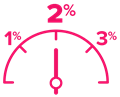
Speed dial icon pointing to 2 percent

We will adjust interest rates to ensure that inflation returns to 2%.

Kia ora, I’m Anna Breman - Governor of the Reserve Bank of New Zealand and chair of the Monetary Policy Committee.

The Monetary Policy Committee decided to hold the Official Cash Rate, the OCR, at 2.25%.

These are challenging times for New Zealanders.

People are paying more at the petrol pump. Businesses are facing rising costs and some of them, fewer customers.

As a Committee, we are focused on ensuring that these short term, unavoidable consequences of the Middle East conflict do not lead to persistently high inflation in New Zealand.

We expect to increase interest rates this year to help keep a lid on inflation. It's a challenging balance.

Increasing interest rates too quickly could stifle economic growth, but moving too slowly could lead to higher inflation and greater costs for New Zealanders in the long run.

We will be watching the economy closely and responding as necessary to ensure that inflation returns to 2%, while avoiding unnecessary volatility in the economy.

If you want to understand a bit more, check out the snapshots on the RBNZ website.

What this means for you

  • Higher fuel prices are making things more expensive for households and families, reducing what they can afford to buy with their income.
  • Fuel prices are likely to remain high, but will come down over time. 
  • We expect inflation to fall to 2% next year. Spare capacity in the economy is limiting how fast prices can increase.

May OCR decision

What's happening in the economy?

Common questions about the OCR

The OCR sets the interest rates on the deposits and loans that registered banks have with us. This affects their earnings and costs, and influences how they set their deposit and loan interest rates for you, as their customer.

Bank products usually have terms of several months to several years — for example, a 6 month term deposit, or a 2-year mortgage. The interest rates on the longer-term products depend on what banks’ think will happen to the OCR over the life of your deposit or loan. 

We can influence interest rates by:

  • setting today’s OCR
  • influencing bank’s expectation for the evolution of the OCR.

This means when we increase expectations for the OCR, banks will usually increase their mortgage rates, business lending rates, and term deposit rates.

If you have a home loan or mortgage

If you have a loan or mortgage on a floating rate, you might have found that the cost of your repayments has gone down over the past year or so.

If you’re on a fixed rate you won’t see any change until the end of your fixed period.

It’s important to understand how a change in interest rates could impact your ability to pay. You can use a mortgage calculator to work out how your monthly payments might be affected.

Try the mortgage calculator on sorted.org.nz


If you are saving for your first home or for your retirement

If you have savings in a bank account that pays interest, then you might have seen interest rates on your savings go down.

We increased interest rates between 2021 and 2023 to help control inflation.

Interest rates influence spending decisions, which affect how businesses set their prices. Higher interest rates increase mortgage and loan payments, and encourage people to save more. This reduces available income to spend on other things and businesses are then less able to raise their prices, which reduces inflation. Since 2022, inflation has come down from 7.2% to within our target range of 1 to 3%.

Since August 2024, we have been reducing the OCR in response to subdued activity data and our lower outlook for inflation. Lower interest rates reduce mortgage and loan payments and mean that people get less back on their savings. Overall, this increases available income to spend on other things. Businesses are then more likely to increase prices, so that inflation settles near within our target range.

We make interest rate decisions 8 times a year. If the economy evolves as expected, interest rates are likely to remain around their current levels for some time.

Videos

Hi, I’m Paul Conway, Chief Economist at Te Pūtea Matua, the Reserve Bank of New Zealand.

I’ve got 5 things I’d like to let you to know about how we do forecasting and monetary policy at the bank.

First, the best thing that we can do with monetary policy for the material wellbeing of New Zealanders is to keep inflation low and stable. Because low inflation means that we can all plan and invest better and that the purchasing power of our wages is not eroded by rising prices.

Second thing, we use interest rates - the Official Cash Rate - to control inflation. For example, over the past few years we have reduced inflation from above 7% to near our 2% inflation target midpoint. Now we do this gradually through time, because trying to bring inflation back to target all at once could sometimes cause unnecessary volatility in the economy.

Three, interest rates take a long time to fully impact inflation in the economy. So we need to project where the economy will be in future so that we can make the right interest rate calls today. We can't see into the future, unfortunately, but with good data, good research, good economic models and highly skilled people, we can get a sense of where the economy is headed.

We need to be like All Whites Captain Chris Wood. He scores goals by moving to where the ball is going, rather than where it is right now.

Four, to forecast the future, we need to know where the economy is at today. Now, that is easier said than done, because official data, it often arrives with a lag and it is often revised. So we do something called nowcasting. And this involves looking at all sorts of data - things like retail spending, the results of business surveys, or car and truck movements - heaps of data. And as that data becomes available, we run it through a model that gives us a nowcast of, for example, GDP growth.

And we've actually just started publishing our nowcasts for GDP growth on our website. We'll update that every Friday afternoon to reflect the data that's come in over the week. So check it out. It's called Kiwi-GDP.

And the final point I want to make, point five, is that our OCR forecasts are always conditional. It is our best foot forward on the day. So as the economic picture changes, and it always does to some extent, our projection for the OCR changes too. So the track for future interest rates is never guaranteed.

Thank you for tuning in.

Ka kite.

Audio: Kia ora, I'm Paul Conway, Chief Economist at the Reserve Bank of New Zealand. Here at Te Pūtea Matua, we use the OCR or Official Cash Rate to achieve and maintain price stability and support maximum sustainable employment in our economy. Our goal is to keep inflation between 1 and 3% over the medium term. But lately inflation has been far too high. For this reason, we have been increasing the OCR to reduce spending and encourage savings. So how does raising the OCR help bring down inflation? Well, higher interest rates make it more expensive for people to borrow and encourage people to save. Borrowers with a mortgage or other debt have to increase their interest payments and so tend to spend less as interest rates rise.

Savers, people with money in the bank earn a higher return on their savings, encouraging them to save more. Higher interest rates also tend to increase the exchange rate, making it effectively cheaper to buy foreign products or imports, which also help bring down overall inflation.

Higher interest rates also mean New Zealanders expect lower inflation in future, which encourages businesses to set lower prices for their products today and for workers to accept lower pay increases, which also works to lower inflation in our economy.

Text on screen: How does the official cash rate affect interest rates in the economy?

Audio: The OCR effectively sets the interest rates on the deposits and loans that commercial banks hold with the Reserve Bank. Banks tend to set the interest rates that they charge and pay on mortgages and deposits over the life of the loan or deposit. So, for example, a two year mortgage rate will factor in what banks predict the OCR to be over the two year term of the loan.

Text on screen: How will raising interest rates affect New Zealanders?

Audio: If you have a floating rate on a loan or mortgage, you're no doubt finding that the cost of your repayments are going up. If you have a fixed rate mortgage, then repayments remain the same until the end of that fixed rate period. And if you have savings, you'll be noticing that you're earning a bit more interest on your money than you were, say, a couple of years ago when interest rates were exceptionally low. This will encourage New Zealanders to spend less and to save more, which will help bring inflation down in our economy.

Inflation is no one's friend. It makes life more expensive and complex for New Zealanders. It's like a pay cut and a tax on your savings rolled into one. This is why it's crucial for the Reserve Bank of New Zealand to get inflation back into our target range. Thank you.